
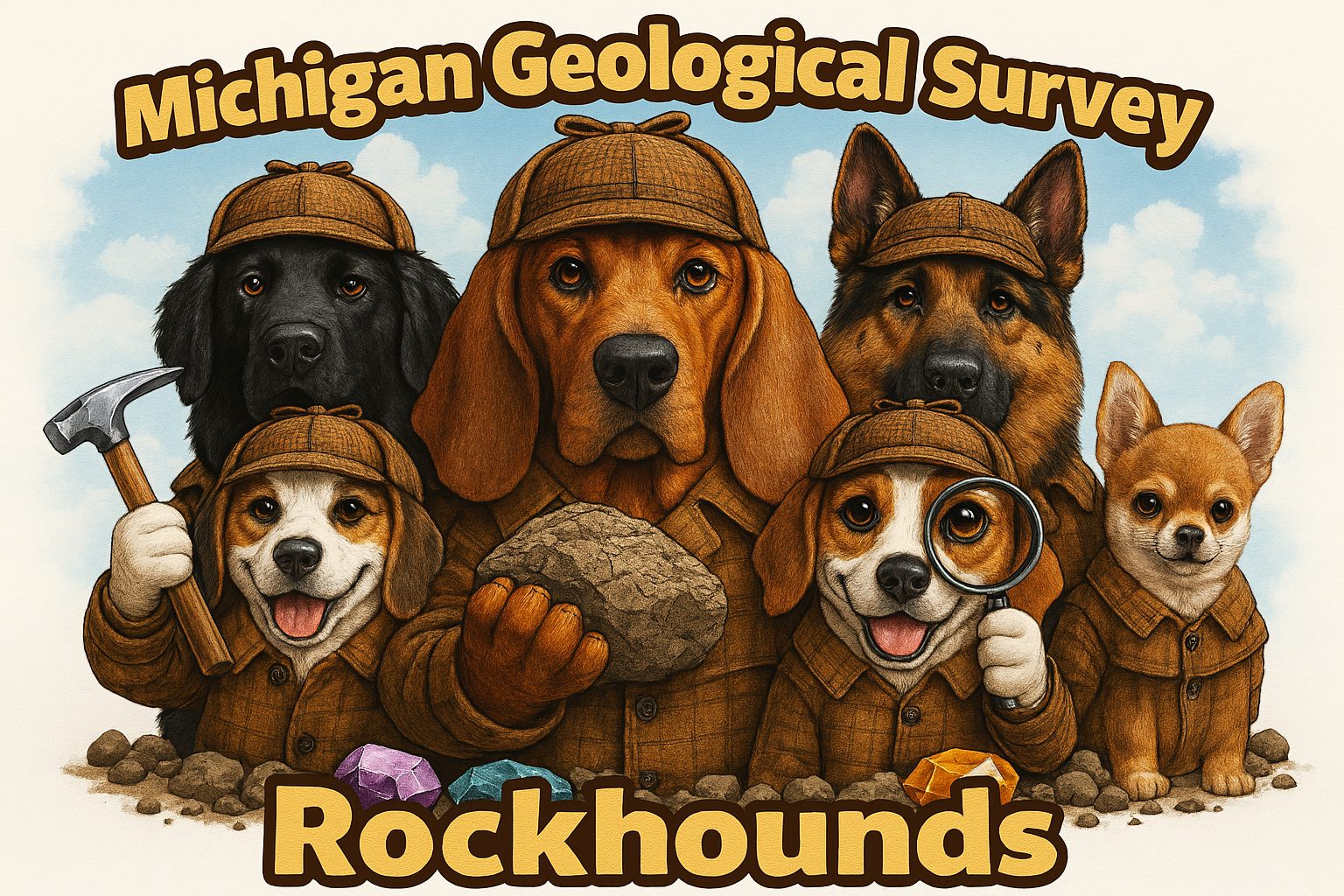
Rockhounds are people who love exploring outside and finding cool and exciting rocks, minerals, and sometimes even fossils! You can find fascinating rocks along the beach, in your own backyard, or in many other places in Michigan and around the world.
Use the resources below to create and print your own Michigan Geological Survey Rockhounds Poster, make Rockhounds Trading Cards, and solve Rockhound Mysteries. We even have a map of Michigan locations where interesting geological features can be found. Happy rock hounding!
Michigan Rockhounding Map
The Michigan Rockhounding Map is designed to help rockhounds, collectors, and outdoor enthusiasts discover locations and regions of geologic interest across the state. Its purpose is to provide a practical starting point for exploring Michigan’s mineral, fossil, and rock-collecting opportunities while encouraging responsible, legal, and respectful field collecting. Users are encouraged to verify all permission and access requirements before visiting any of these sites.
Michigan GeoFinds Reporting Tool
The Michigan GeoFinds Reporting Tool is a citizen science initiative that invites rockhounds, hikers, students, and other outdoor enthusiasts to help document Michigan’s geologic discoveries. By sharing observations of rocks, minerals, fossils, and other geologic materials, participants contribute valuable information that can support public education, outreach, and a broader understanding of Michigan’s diverse geologic landscape.
Rockhound Trading Card Activity
- How to Make Trading Cards
- Rockhound Cards Digital Templates
- Rockhound Card Paper Templates
- Rockhounds Mystery Mad Libs
Where collecting is allowed in Michigan
Michigan is one of the best states in the country for rockhounding, but it comes with clear rules designed to protect natural resources. Always follow Michigan Department of Natural Resources (DNR) guidelines and local regulations.
State-Owned Land & Great Lakes Shorelines
Rockhounding is allowed on most state land, including:
- State parks and recreation areas.
- State forests.
- Great Lakes beaches (below the ordinary high water mark).
Public Trust Areas
This includes lakebeds and shorelines along the Great Lakes—popular for Petoskey stones, agates, and fossils.
National Forests (e.g., Hiawatha, Ottawa)
Small amounts of rock collection are allowed for personal use.
Private Property with Permission
You must have explicit permission from the landowner.
Where collecting isn't allowed in Michigan
National Parks & National Lakeshores:
Collecting any rocks, minerals, or fossils within a national park or lakeshore (e.g. Sleeping Bear Dunes or Pictured Rocks National Lakeshore) is illegal.
Historic or Protected Sites:
- Archaeological areas.
- Historic parks (such as Fayette Historic State Park).
- Scientific or nature preserves.
Private Land without Permission:
Trespassing laws apply and can result in fines.
How much can you collect in Michigan?
Michigan has some of the clearest rules in the nation:
State Land & Public Shorelines
- Total of 25 pounds per person per year.
- Applies across all trips combined—not per visit.
- Includes rocks, minerals, and invertebrate fossils.
- Personal, non-commercial use only.
- Selling or trading collected material is not allowed without permits.
National Forests (Federal Land)
- Small, “reasonable” personal-use quantities allowed.
- Hand tools only.
Private Property
No limit with landowner permission.
Exceptions
Man-made materials like slag glass (e.g., Leland Blue) are often not included in limits.
Basic Rockhounding Equipment
Essential Gear:
- Safety glasses.
- Gloves.
- Sturdy footwear (wet rocks can be slippery).
Recommended Tools:
- Rock hammer (where allowed).
- Small chisel.
- Bucket or backpack.
- Hand lens (10x magnification).
- Spray bottle (brings out color in stones).
- Water shoes for shoreline hunting.
- A mesh bag for wet rocks.
- UV flashlight (for Yooperlites at night).
Safety Items:
- First aid kit.
- Drinking water.
- Sunscreen & weather-appropriate gear.
- Anti-bug repellent for flies and mosquitos ; wear long pants, long-sleeved shirts, and cover your head with a bug net.
Contact Our Team
Please use the link below to contact our Education and Outreach staff for general information.
Request Services
Please use the link below to complete a request for school visits, field trips, or other direct services.
Support CoreKids
Follow the link below to send a gift to the Michigan Geological Survey’s Corekids program.